
Nurses in the United States are usually licensed in a specific state, but the Nurse Licensure Compact (NLC) is changing that by allowing a single license to be valid across multiple states.
This compact makes it easier for nurses to move or work in different states without needing to obtain a new license each time. It’s especially helpful for internationally trained nurses coming to the U.S., because they won’t have to go through separate licensing processes for every state they want to work in.
What is the NLC?
The Nurse Licensure Compact is essentially an agreement between states that lets registered nurses (RNs) and licensed practical/vocational nurses (LPN/LVNs) have one multistate license valid in all participating states. In other words, if you hold a nursing license in an NLC member state (your “home state”), you are allowed to practice (either in person or via telehealth) in any other compact member state without getting a separate license there.
This works similar to how states recognize each other’s driver’s licenses – your home state issues the license, and other member states honor it. Of course, to get a multistate license, a nurse must meet certain standards (like a background check and passing the NCLEX exam) which are uniform across compact states. But once those requirements are met, the NLC greatly reduces regulatory barriers to practicing across state lines.
Benefits for International Nurses
The NLC offers several benefits that are especially valuable for nurses who trained abroad or plan to move between states.
First, it provides greater mobility – a nurse with a multistate license can relocate or take travel assignments in other compact states without the hassle of obtaining a new license each time. This flexibility is a huge advantage for foreign nurses coming to the U.S., as it widens the job opportunities beyond a single state.
Second, the compact helps address nursing shortages by allowing nurses to quickly start working where demand is high, increasing access to care in multiple states. For example, a nurse who got licensed in Texas can immediately also practice in Florida or Pennsylvania under the NLC, which makes it easier to respond to staffing needs across the country.
Additionally, the NLC makes telehealth nursing simpler – a nurse can consult patients in other compact states legally, which is beneficial in an era of remote healthcare.
Overall, for an internationally educated nurse, a multistate license means less paperwork, lower fees (by avoiding multiple license applications), and the freedom to explore jobs in dozens of states as their career evolves.
What about NLC States in 2026?
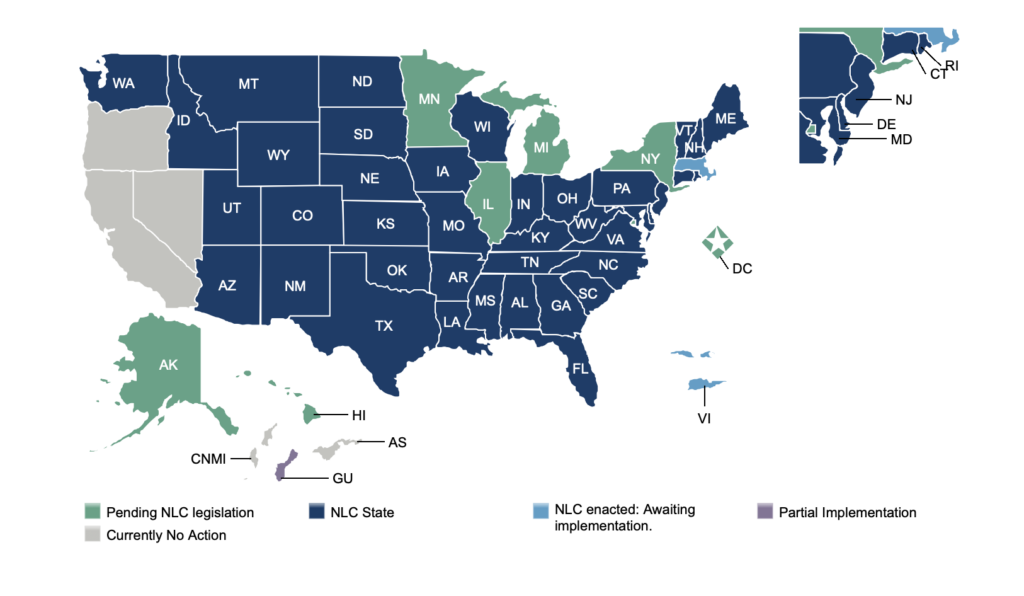
NLC coverage map as of 2026: Dark blue states are full NLC members, orange indicates states that have enacted NLC but are awaiting implementation, and light blue shows states with pending NLC legislation.
As of March 2026, 43 U.S. states and territories have joined the Nurse Licensure Compact in full. This means nurses holding a multistate license can practice in a majority of the country. The member states span every region – from southern states like Florida and Texas to western states like Colorado and Washington, and many in between.
In fact, NLC member states include Alabama, Arizona, Arkansas, Colorado, Connecticut, Delaware, Florida, Georgia, Guam, Idaho, Indiana, Iowa, Kansas, Kentucky, Louisiana, Maine, Maryland, Massachusetts (partially), Mississippi, Missouri, Montana, Nebraska, New Hampshire, New Jersey, New Mexico, North Carolina, North Dakota, Ohio, Oklahoma, Pennsylvania, Rhode Island, South Carolina, South Dakota, Tennessee, Texas, Utah, Vermont, Virginia, Virgin Islands (partially), Washington, West Virginia, Wisconsin, and Wyoming.
Together, these 43 jurisdictions cover a large portion of the U.S. population and geography. Nurses living in any of these states can obtain a multistate license and have the privilege to work in all the others on that list.
However, a few populous states are not yet part of the NLC. Notably, California, New York, Illinois, Michigan, Oregon, Nevada, Hawaii, and Minnesota have not joined the compact as of 2026. In those non-compact states, nurses still must obtain a separate state license to practice. (For example, a nurse licensed in California cannot use that license in other states unless those states individually endorse it, since California is outside the NLC.)
It’s important for nurses and employers to check whether a state is an NLC member or not, as this affects licensing requirements. Always verify the latest status on official sites like NCSBN or NurseCompact.com, as changes are possible.